On the eastern coast of Mallorca, beneath the quiet town of Porto Cristo, lies one of the Mediterranean's most celebrated natural wonders. The Cuevas del Drach, or Dragon Caves, comprise four interconnected caverns that stretch nearly 4 kilometres into the earth, reaching depths of 25 metres below the surface. Their centrepiece, Lake Martel, is among the largest underground lakes in the world.
Centuries of Exploration
The existence of the Dragon Caves has been known since the Middle Ages. The first documented reference dates to 1338, when soldiers of the Governor of Mallorca explored the caverns searching for hidden Templar treasures. Over the centuries, the caves attracted the curiosity of scholars and adventurers, but a full exploration did not occur until the late 19th century.
In 1896, the French speleologist Edouard-Alfred Martel was commissioned by Archduke Ludwig Salvator of Austria to conduct a thorough survey. Martel's expedition revealed the full extent of the cave system and, crucially, discovered the immense underground lake that now bears his name. His detailed maps and descriptions transformed the caves from a local curiosity into an international attraction.
The Four Caves
The system consists of four distinct caves, each connected to the next and named over different periods of exploration:
Black Cave (Cueva Negra)
The first cavern encountered on the visitor route, the Black Cave gets its name from the deep shadows that fill its recesses. Its walls are lined with flowstone formations that have been shaped by millennia of slow water deposition.
White Cave (Cueva Blanca)
Named for the pale calcite deposits that cover much of its surfaces, the White Cave provides a stark contrast to its darker neighbour. The lighter formations here include delicate curtains of translucent stone.
Cave of Luis Salvador (Cueva de Luis Salvador)
Named in honour of Archduke Ludwig Salvator, who funded Martel's expedition, this section features some of the most dramatic formations in the system, including towering columns where stalactites and stalagmites have merged over geological time.
Cave of the French (Cueva de los Franceses)
The deepest section of the system, named for the French speleologist who mapped it. This cave leads visitors to the shore of Lake Martel, the highlight of any visit.
Lake Martel
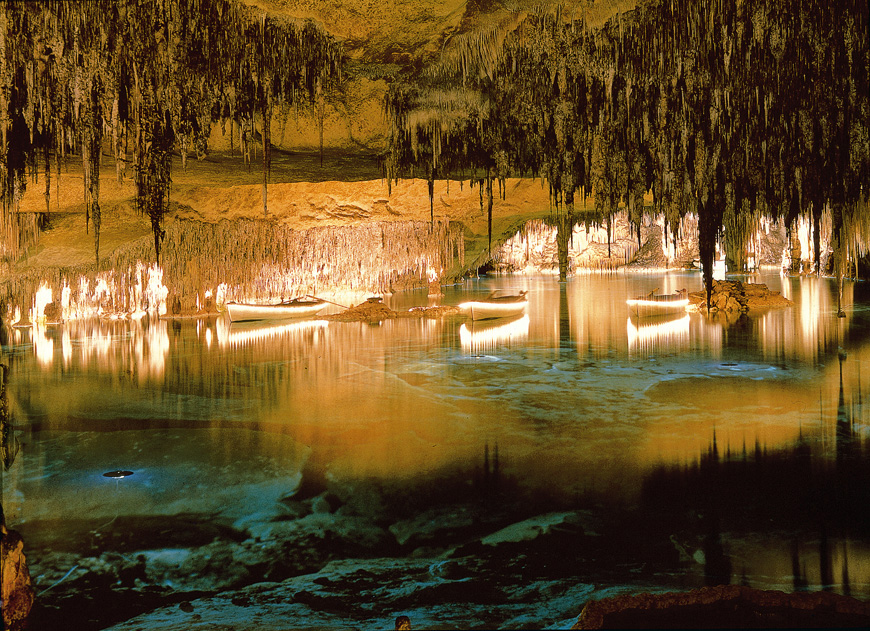
Measuring approximately 115 metres long and 30 metres wide, Lake Martel is one of the largest underground lakes in the world. Its waters, fed by the Mediterranean through subterranean channels, are remarkably clear and maintain a temperature of about 17 to 18 degrees Celsius throughout the year.
The lake's most famous feature is not geological but musical. At the conclusion of each guided tour, the lights are dimmed to near-total darkness. Then, from the far end of the lake, small illuminated boats appear, carrying musicians who perform classical compositions. The acoustics of the cavern, combined with the water's natural amplification, create a sound environment unlike any concert hall above ground.
The moment the lights go out and the first notes of Chopin drift across the black water of Lake Martel, you forget you are 25 metres underground. The music and the darkness erase every boundary between the cave and your imagination.
Geological Formation
The caves were carved out of Upper Miocene limestone by the action of water flowing toward the Mediterranean coast. Over millions of years, slightly acidic rainwater dissolved the calcium carbonate in the rock, creating the passages and chambers visible today. The process continues, though at a pace measured in centimetres per millennium.
The formations inside the caves include classic stalactites and stalagmites, but also less common types such as helictites, which grow in seemingly gravity-defying directions due to capillary forces, and cave pearls, which form in shallow pools through the layered deposition of calcite around a nucleus.
Practical Information
| Location | Ctra. Cuevas s/n, 07680 Porto Cristo, Mallorca, Balearic Islands |
| Opening Hours | 10:30 AM - 5:00 PM (varies by season, check official website) |
| Tour Duration | Approximately 1 hour (includes concert) |
| Temperature Inside | Around 21 degrees Celsius |
| Accessibility | Steps and uneven terrain; limited wheelchair access |
| Nearest Airport | Palma de Mallorca (approx. 65 km) |
| Official Website | cuevasdeldrach.com |
Planning Your Visit
The caves are one of Mallorca's most popular attractions, and tours can sell out quickly during the summer months. Booking online in advance is strongly recommended, especially for visits between June and September.
Porto Cristo itself is a pleasant coastal town worth exploring. The harbour area and beach are within walking distance of the cave entrance, making it easy to combine a cave visit with a seaside lunch or a stroll along the promenade.
For those exploring Mallorca's cave landscape more broadly, the nearby Coves d'Arta (about 15 kilometres north) offer a less crowded alternative with equally impressive formations. Combining both visits in a single day is easily done by car.
Conservation and Future
Managing the balance between tourism and conservation is an ongoing challenge. Visitor numbers are carefully controlled to limit the impact of CO2, humidity changes, and lighting on the delicate formations. The cave's management has invested in LED lighting systems that produce less heat and are less likely to promote algae growth on the rock surfaces.